physdes.steiner_forest namespace
Submodules
physdes.steiner_forest.congestion_map module
- physdes.steiner_forest.congestion_map.draw_congestion_map(grid, filename='congestion_map.svg')[source]
Generate an SVG visualization of a network congestion map.
This function creates an SVG image showing a grid where each cell’s color represents its congestion level (0-100%), using a green-yellow-red gradient.
- Parameters:
Examples
>>> grid = [[0, 50, 100], [25, 75, 50]]
>>> draw_congestion_map(grid, "test.svg")
Congestion map saved to test.svg
physdes.steiner_forest.steiner_forest_grid module
- class physdes.steiner_forest.steiner_forest_grid.UnionFind(size)[source]
Bases:
objectA Union-Find (Disjoint Set Union) data structure with path compression and union by rank.
This implementation supports efficient union and find operations for managing connected components, commonly used in graph algorithms like Kruskal’s MST.
Examples
>>> uf = UnionFind(10)
>>> uf.union(1, 2)
True
>>> uf.union(2, 3)
True
>>> uf.find(1) == uf.find(3)
True
>>> uf.union(1, 3)
False
- __init__(size)[source]
Initialize the Union-Find structure.
- Parameters:
size (int) – The number of elements in the set.
- physdes.steiner_forest.steiner_forest_grid.generate_svg(height, width, F_pruned, sources, terminals, steiner_nodes, cell_size, margin, filename)[source]
Generate an SVG visualization of a Steiner forest on a grid.
This function creates an SVG image showing the grid with nodes (sources in red, terminals in green, Steiner nodes in blue) and selected edges highlighted.
- Parameters:
height (int) – Grid height.
width (int) – Grid width.
F_pruned (List[Tuple[int, int, float]]) – List of edges in the Steiner forest as (u, v, cost) tuples.
sources (Set[int]) – Set of source node indices.
terminals (Set[int]) – Set of terminal node indices.
steiner_nodes (Set[int]) – Set of Steiner node indices.
cell_size (int) – Size of each grid cell in pixels.
margin (int) – Margin around the grid in pixels.
filename (str) – Output SVG filename.
- physdes.steiner_forest.steiner_forest_grid.steiner_forest_grid(height, width, pairs)[source]
Computes an approximate Steiner forest on a grid graph.
The algorithm is based on the primal-dual approach for the Steiner network problem. It iteratively pays for edges until all terminal pairs are connected.
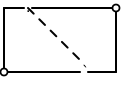
The following diagram illustrates the concept of a Steiner tree, where ‘o’ represents terminals and ‘*’ represents Steiner points.
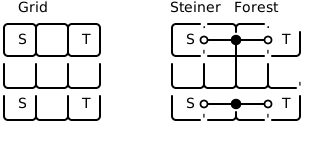
In our case, we are looking for a Steiner forest, which is a collection of Steiner trees connecting specified pairs of terminals.
The algorithm works by “growing” paths from terminals. Each active component (a connected component containing at least one terminal that needs to be connected to a terminal in another component) contributes to the cost of edges.
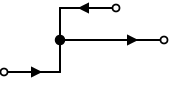
When the cost paid for an edge equals its weight, the edge is added to the forest.
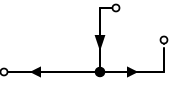
The following diagrams illustrate the concept in 3D as well.
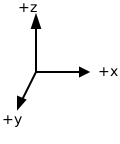
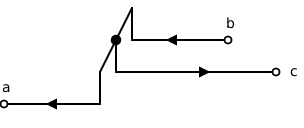
After the growing phase, a reverse-delete step is performed to remove redundant edges from the forest.
>>> h = 2
>>> w = 2
>>> pairs = [((0, 0), (1, 1))]
>>> F_pruned, total_cost, sources, terminals, steiner_nodes = steiner_forest_grid(h, w, pairs)
>>> sorted(F_pruned)
[(0, 1, 1.0), (1, 3, 1.0)]
>>> total_cost
2.0
>>> sources
{0}
>>> terminals
{3}
>>> steiner_nodes
{1}